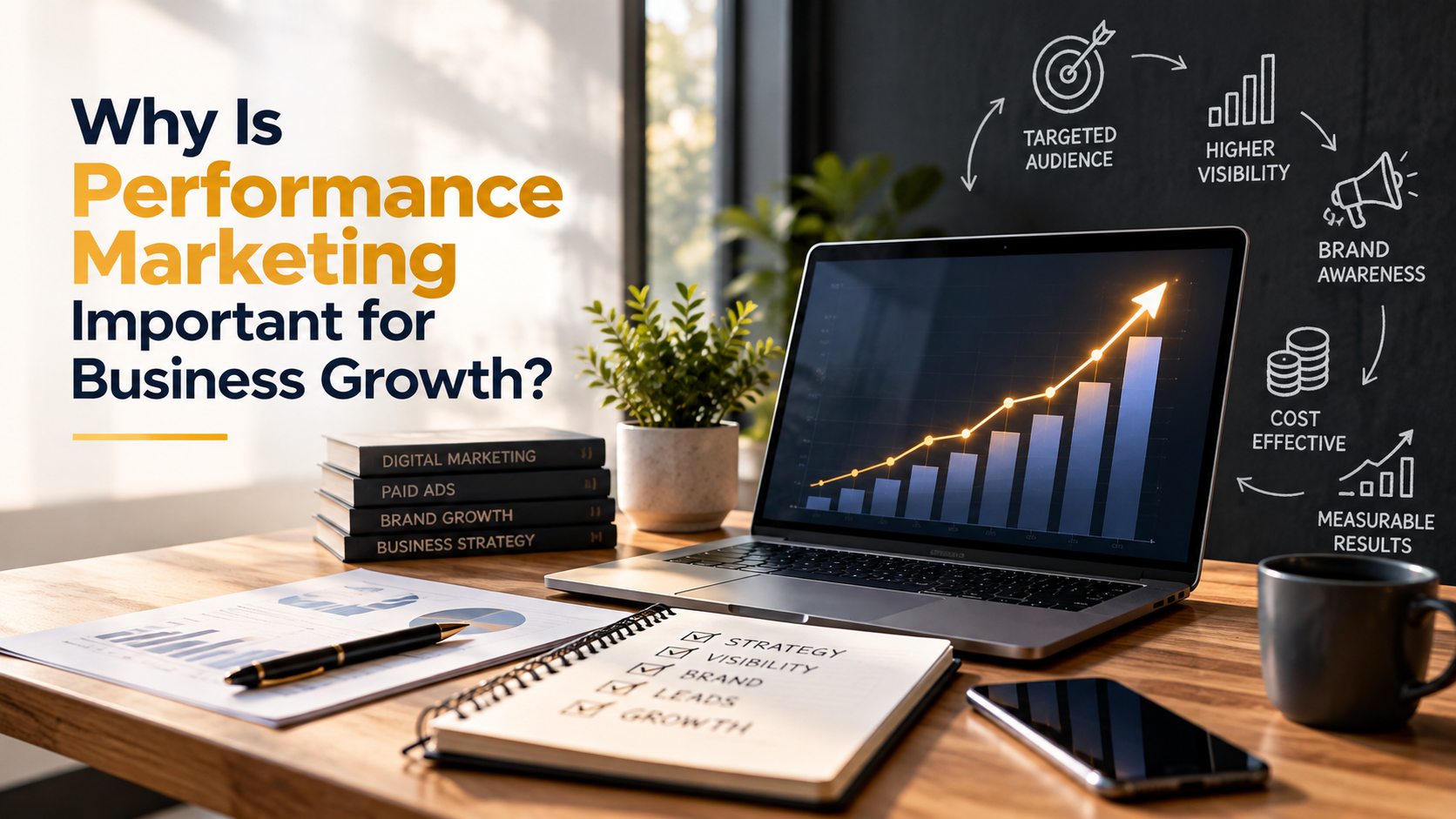
Why Does Your Business Need Performance Marketing?
14-10-2026
Why Does Your Business Need Performance Marketing? 12 Benefits That Drive Growth
Every business wants more customers, better brand visibility, and higher returns on its marketing investment. However, traditional marketing methods can make it difficult to understand which activities generate leads, sales, and revenue.
This is where performance marketing makes a difference.
Performance marketing helps businesses reach the right audience, run targeted advertising campaigns, track results, and improve marketing performance using real data. Whether you are a startup, a local business, or an established company, the right strategy can help you attract potential customers and grow your business.
If you are looking for a Performance Marketing Agency in Ahmedabad, Fruxinfo can help you build a data-driven marketing strategy focused on your business goals.
In this blog, we will explore 12 key benefits of performance marketing and how Fruxinfo supports businesses through strategic planning, content creation, paid advertising, analytics, and financial marketing planning.
What Is Performance Marketing?
Performance marketing is a digital marketing approach in which campaigns are planned, tracked, and optimized using measurable results such as clicks, leads, sales, conversions, and return on advertising spend (ROAS).
Instead of focusing only on impressions or brand exposure, performance marketing connects marketing activities with specific business objectives.
For example, a business can run Google Ads to attract people searching for its services or use Meta Ads to reach potential customers based on their interests and behaviour. The results can then be measured to understand which campaigns are performing well.
A professional performance marketing strategy combines audience research, campaign planning, creative development, budget management, conversion tracking, and continuous optimization.
Why Does Your Business Need Performance Marketing?
Businesses need performance marketing to reach potential customers, manage advertising budgets, understand campaign results, and make informed marketing decisions. Here are 12 important benefits.
1. Exclusive Marketing Strategy for Your Business
Every business has different goals, customers, competitors, and budgets. A marketing strategy that works for one company may not work for another.
Performance marketing starts with understanding your business, identifying your target audience, researching competitors, and selecting the right advertising channels.
For example, a B2B manufacturing company may need Google Search Ads to reach buyers actively searching for machinery. A local service business may benefit from location-based Google Ads and Meta campaigns.
A customized strategy helps businesses focus on relevant audiences and meaningful results instead of following a one-size-fits-all approach.
2. Increase Your Online Visibility
Your potential customers are searching online for products, services, and solutions. If your business does not appear when they are looking, you may miss valuable opportunities.
Performance marketing can improve your visibility through Google Search Ads, Meta Ads, remarketing, and other paid advertising channels.
A Google Ads Agency can help your business appear for relevant search queries, while a Meta Ads Agency can help introduce your brand to potential customers on Facebook and Instagram.
The goal is to reach the right people at the right stage of their buying journey.
3. Build Strong Brand Awareness
Customers are more likely to consider a business when they recognize its name, services, and value.
Performance marketing can support brand awareness through targeted campaigns, engaging creatives, videos, and repeated exposure to relevant audiences.
For example, a new business in Ahmedabad can use Meta Ads to introduce its services to local audiences and Google Ads to reach people who are actively searching for those services.
Combining awareness campaigns with lead generation and remarketing can help businesses stay visible throughout the customer journey.
4. Make Better Use of Your Marketing Budget
Marketing budgets are valuable, especially for startups and small businesses. Spending money without understanding campaign performance can lead to wasted opportunities.
Performance marketing allows businesses to track spending, cost per click (CPC), cost per lead (CPL), conversion rates, and revenue where tracking is available.
These insights help marketers identify underperforming campaigns, adjust budgets, improve targeting, and invest more in strategies that deliver results.
However, cost-effective marketing does not always mean choosing the cheapest clicks. The real objective is to generate valuable customers at a sustainable acquisition cost.
5. Reach the Right Target Audience
Showing your advertisements to everyone is rarely an effective strategy.
Performance marketing uses audience research, search intent, demographics, interests, location, and campaign data to reach people who are more likely to need your products or services.
For example:
-
A local clinic may target relevant audiences within its service area.
-
A B2B machinery manufacturer may target businesses searching for industrial equipment.
-
An e-commerce brand may use remarketing to reconnect with visitors who viewed products but did not purchase.
Accurate targeting can reduce irrelevant traffic and improve the quality of leads. Results still depend on the offer, creative, competition, and landing-page experience.
6. Measure Every Important Marketing Result
One of the biggest advantages of performance marketing is measurability.
Businesses can monitor campaign performance and understand how their advertising investment contributes to business outcomes.
Important performance metrics include:
-
Impressions and reach
-
Click-through rate (CTR)
-
Cost per click (CPC)
-
Cost per lead (CPL)
-
Conversion rate
-
Customer acquisition cost (CAC)
-
Return on advertising spend (ROAS)
For example, if a campaign receives many clicks but very few leads, the problem could be related to audience quality, ad messaging, landing-page experience, or conversion tracking.
Data helps businesses identify these issues and make more informed decisions.
7. Customize Campaigns as Your Business Grows
Business goals change over time. A startup may initially focus on brand awareness, while an established company may prioritize qualified leads, online sales, or customer retention.
Performance marketing campaigns can be adjusted according to business objectives, audience behaviour, budget, location, and campaign results.
Businesses can test different ad creatives, headlines, offers, keywords, landing pages, and audience segments to discover what works best.
This flexibility makes performance marketing suitable for businesses at different stages of growth.
8. Understand Your Market and Competitors
Understanding your market is essential for making better marketing decisions.
Performance marketing data can reveal which search terms attract clicks, which audiences convert, what messaging generates engagement, and which offers receive a stronger response.
Competitor research can also help businesses identify market positioning, customer expectations, potential opportunities, and gaps in their marketing approach.
These insights can support better campaign planning, content development, and budget allocation.
Remember that advertising platforms do not reveal every competitor's private campaign metric. Market analysis should combine available advertising insights with keyword research, customer feedback, and business data.
9. Expand Your Geographical Reach
Performance marketing allows businesses to reach customers beyond their immediate location.
A local business can focus on Ahmedabad, a company serving multiple Indian cities can expand its campaigns across India, and an eligible business can explore international markets.
Geographical targeting helps businesses align advertising with their service areas, distribution capabilities, and growth plans.
For example, a Performance Marketing Company in Ahmedabad can help a local service provider attract nearby customers while supporting a B2B company that wants to generate leads from other Indian states or international markets.
The best approach is to expand gradually based on demand, budget, and campaign performance.
10. Create a Consistent and Recognizable Brand
Performance marketing is not only about generating immediate leads. It can also support long-term brand development.
Consistent messaging, quality content, professional creatives, and relevant customer interactions help businesses communicate their value more effectively.
Content creation, social media management, community engagement, and paid campaigns can work together to create a consistent brand experience.
When customers repeatedly encounter clear and relevant messaging, they can develop greater familiarity with the business. Actual trust and loyalty still depend on the quality of the product, service, and customer experience.
11. Analyze Competitors and Plan Future Growth
Successful marketing requires more than reacting to current campaign results. Businesses also need to understand changing customer behaviour and prepare for future opportunities.
Performance marketing data can help identify emerging search demand, high-performing products or services, customer acquisition trends, and potential growth opportunities.
Businesses can use these insights to plan future campaigns, test new channels, and allocate budgets more effectively.
For example, if search campaigns consistently generate qualified leads for one service, a business may explore expanding that service into additional locations or developing dedicated landing pages for different customer segments.
Data-driven planning makes marketing decisions more structured, although future results can never be guaranteed.
12. Support Aggressive and Scalable Marketing
Businesses with ambitious growth targets often need a marketing approach that can scale with demand.
Performance marketing allows businesses to test campaigns, identify profitable opportunities, and gradually increase investment when results support expansion.
Scaling should be based on lead quality, conversion rates, acquisition costs, revenue, and available business capacity—not simply on the number of clicks or leads generated.
With a clear strategy and regular optimization, businesses can pursue growth while keeping their marketing investment accountable.
What Is the Difference Between Performance Marketing and Digital Marketing?
Performance marketing is a part of digital marketing that focuses strongly on measurable outcomes. Digital marketing is the broader category that includes paid advertising, SEO, content marketing, social media, email marketing, and other online activities.
Here is a simple comparison.
| Factor | Performance Marketing | Digital Marketing |
|---|---|---|
| Main focus | Measurable campaign outcomes | Overall online presence and growth |
| Common activities | Google Ads, Meta Ads, PPC, conversion optimization | SEO, content, social media, paid ads, email |
| Measurement | Leads, sales, CPL, CAC, ROAS | Traffic, visibility, engagement, leads, sales |
| Optimization | Campaign and conversion performance | Overall channel and marketing performance |
| Time horizon | Often focused on measurable campaign results | Can support both short-term and long-term growth |
Both approaches are important. Performance marketing can generate measurable demand, while SEO, content marketing, and brand-building activities can strengthen long-term visibility.
The right mix depends on your business goals, customer journey, competition, and available budget.
How Can Fruxinfo Help Your Business with Performance Marketing?
Choosing the right strategy and executing it consistently are both important for successful marketing.
Fruxinfo helps businesses approach performance marketing through strategic planning, creative execution, paid campaigns, audience engagement, analytics, and budget planning.
1. Strategy and Ideation
We begin by understanding your business objectives, target customers, services, competitors, and growth opportunities.
This helps establish campaign goals, audience segments, advertising channels, and a practical marketing roadmap.
2. Content Creation and Planning
Strong advertising requires clear messaging and relevant creatives.
Content planning can include ad copy, social media posts, campaign creatives, videos, promotional messaging, and content calendars designed around your business objectives.
3. Account Management, Community Engagement and Growth
Campaign performance depends on more than advertisements alone.
Account management, regular monitoring, audience engagement, and consistent communication can help maintain a professional brand presence and support customer relationships.
4. Paid Advertising Campaigns
Fruxinfo can support paid advertising strategies across suitable platforms, including Google Ads and Meta Ads.
Our campaign planning focuses on relevant targeting, keyword selection, ad creatives, budget allocation, conversion tracking, and ongoing optimization.
Our PPC Services can help businesses connect advertising spend with measurable goals such as qualified leads, sales, and customer acquisition.
5. Analytics and Reporting
Marketing decisions become stronger when they are supported by reliable data.
Campaign reporting can include impressions, clicks, CTR, CPC, conversions, CPL, conversion rates, and ROAS where the necessary tracking and revenue data are available.
These reports help businesses understand what is working, identify areas for improvement, and make informed decisions about future campaigns.
6. Financial Marketing Planning
A marketing budget should support business goals and expected returns.
Financial marketing planning considers advertising costs, lead acquisition targets, conversion rates, customer value, and available resources.
For example, a business generating leads through Google Ads should evaluate not only the cost of each lead but also how many leads become paying customers and how much revenue they generate.
This approach helps connect marketing activity with business performance.
Why Choose a Performance Marketing Agency in Ahmedabad?
Working with a professional marketing partner can help businesses organize their strategy, campaign execution, and performance measurement.
When evaluating a performance marketing partner, look for:
-
A clear understanding of your business goals and target audience.
-
Transparent reporting and meaningful performance metrics.
-
A structured approach to Google Ads and Meta Ads.
-
Proper conversion tracking and campaign optimization.
-
Budget planning based on business objectives.
-
Regular communication and actionable recommendations.
Fruxinfo works to align marketing strategy, creative execution, paid campaigns, and analytics with your business goals.
If you are searching for a Performance Marketing Agency in Ahmedabad or a Performance Marketing Company in Ahmedabad, choose a partner that understands how to connect campaign performance with business outcomes.
Frequently Asked Questions About Performance Marketing
1. What is performance marketing in simple words?
Performance marketing is a digital marketing approach that tracks measurable results such as clicks, leads, sales, conversions, and advertising returns. It helps businesses understand how their campaigns perform and where improvements are needed.
2. Why is performance marketing important for businesses?
Performance marketing helps businesses reach relevant audiences, measure campaign results, manage advertising budgets, generate leads, and make data-driven decisions. Its effectiveness depends on campaign strategy, tracking accuracy, offer quality, and conversion experience.
3. How much does performance marketing cost in Ahmedabad?
The cost depends on advertising budget, competition, campaign objectives, platforms, creative requirements, and agency fees. Businesses should define their budget based on customer acquisition goals and expected returns rather than choosing a budget solely on the basis of industry averages.
4. What services does a performance marketing agency provide?
A performance marketing agency may provide strategy development, audience research, Google Ads, Meta Ads, PPC Services, creative planning, landing-page recommendations, conversion tracking, analytics reporting, and campaign optimization.
5. What is ROAS in performance marketing?
ROAS stands for Return on Advertising Spend. It measures the revenue attributed to advertising relative to the advertising cost.
Formula: ROAS = Advertising Revenue ÷ Advertising Spend
For example, if an advertising campaign generates ₹50,000 in attributed revenue from ₹10,000 in ad spend, its ROAS is 5x.
A 5x ROAS does not automatically mean a 5x profit because product costs, operating expenses, agency fees, and other expenses must also be considered.
6. Is Google Ads or Meta Ads better for my business?
Google Ads is often useful for reaching people actively searching for a product or service. Meta Ads can be effective for discovery, audience targeting, visual storytelling, and remarketing. The right choice depends on your audience, sales process, budget, and campaign objective. Many businesses benefit from testing both platforms.
7. How long does performance marketing take to generate results?
Some campaigns can generate clicks or enquiries shortly after launch, but reliable performance evaluation takes time. Results depend on the industry, budget, competition, offer, conversion tracking, and sales cycle. Campaigns need regular monitoring and enough relevant data before major optimization decisions are made.
8. Can small businesses benefit from performance marketing?
Yes. Small businesses can use targeted campaigns to reach relevant customers, test offers, generate enquiries, and measure spending. Starting with a focused audience, clear conversion goals, and a manageable budget can help control risk.
9. How do I choose the right Performance Marketing Agency in Ahmedabad?
Look for an agency that understands your business, explains its strategy clearly, sets measurable goals, tracks conversions correctly, provides transparent reports, and makes decisions using campaign data. Ask how it measures lead quality and business outcomes, not only clicks and impressions.
Grow Your Business with a Data-Driven Marketing Strategy
Performance marketing gives businesses a structured way to reach potential customers, test marketing strategies, measure results, and identify opportunities for growth.
From increasing online visibility and generating qualified leads to managing advertising budgets and understanding campaign performance, the right strategy can help businesses make better marketing decisions.
At Fruxinfo, our approach combines strategy and ideation, content planning, account management, paid advertising, analytics reporting, and financial marketing planning.
If your business wants to improve its online advertising and build a measurable growth strategy, explore Fruxinfo's Performance Marketing Services.
Ready to plan your next marketing campaign?
Contact Fruxinfo to discuss your business goals and explore a performance marketing strategy aligned with your target audience, budget, and growth objectives.
Related Services
Want to put these ideas into practice? Talk to Fruxinfo Ahmedabad about:



