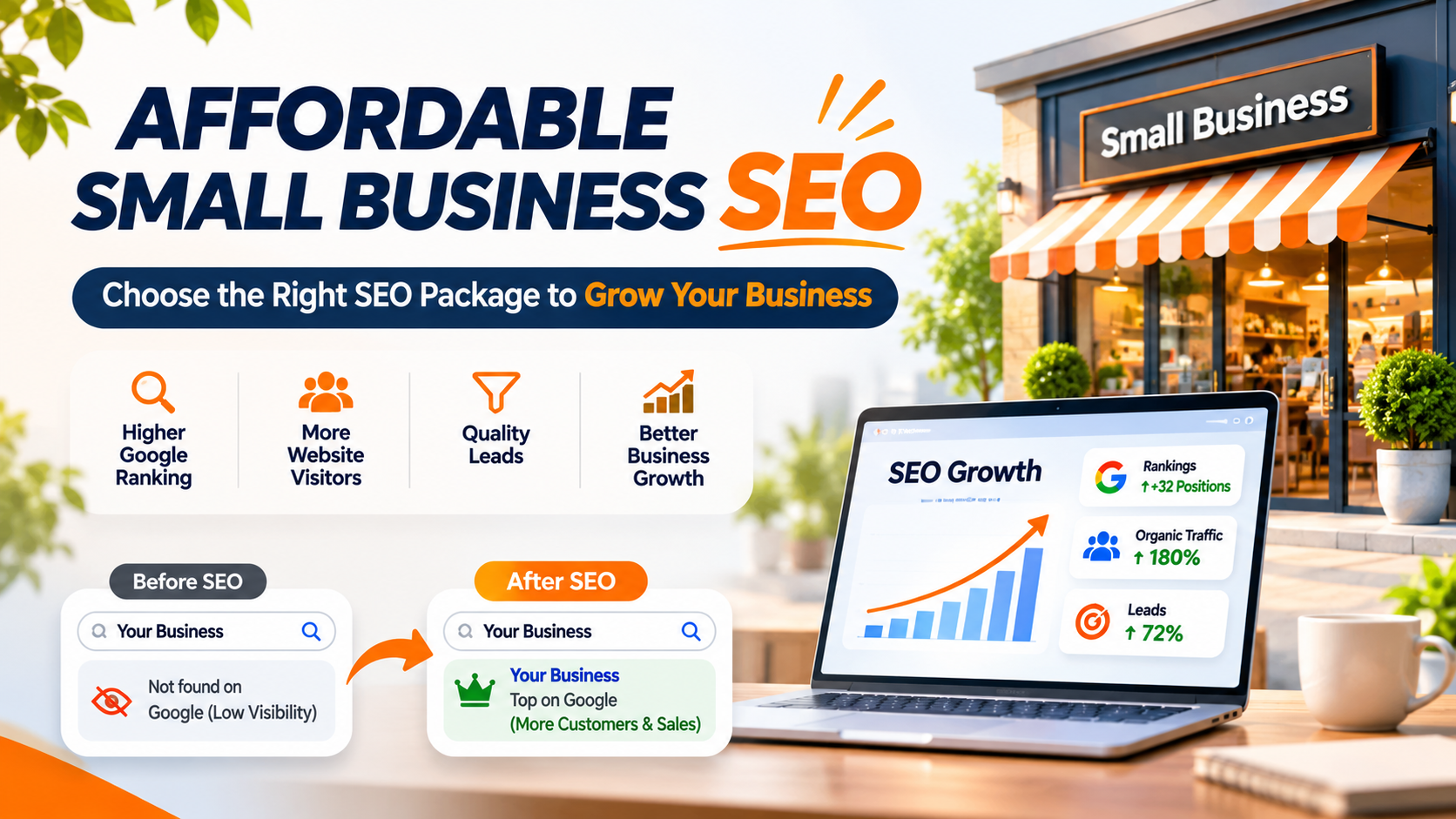
Affordable Small Business SEO: How to Choose the Right SEO Package
11-11-2026
A practical guide to SEO pricing, services, problem-solving and sustainable business growth
Small businesses often know they need to appear on Google, but choosing an SEO service can feel confusing. One agency promises quick rankings, another offers hundreds of backlinks, and a third quotes a monthly price without clearly explaining what is included. The real question is not simply, “Which package is cheapest?” It is, “Which SEO work will solve my business problems and help the right customers find me?”
This guide explains what affordable small business SEO should include, how to compare packages, what affects pricing, and how to recognise work that can produce meaningful progress. It is written for local businesses, startups and growing companies that need a practical way to invest in search visibility without wasting budget.
1. Why Small Businesses Need SEO
Potential customers use search engines when they need a product, service or answer. They may search for a nearby service provider, compare different companies, check prices, read reviews or look for a solution to a specific problem. If your business does not appear for relevant searches, customers may choose a competitor whose website provides clearer information.
Search engine optimisation (SEO) improves the chances that your website and business listings will appear when people search for relevant products or services. Unlike paid advertising, organic visibility does not depend on paying for every click. However, SEO requires time, consistent work and useful content; rankings and leads are never guaranteed.
For a small business, good SEO is not about attracting the largest possible number of visitors. It is about attracting people who are likely to become customers. A local plumber, for example, needs enquiries from people in its service area—not thousands of unrelated visits from other countries.
2. What Are SEO Packages for Small Businesses?
An SEO package is a planned set of optimisation activities delivered over an agreed period, usually monthly. A useful package connects those activities to the business's goals, current website condition, competition, service area and available budget. It should explain what the agency will do, why the work matters and how progress will be measured.
There is no single package that suits every business. A new website may need technical setup and foundational content. An established local company may need stronger location pages, Google Business Profile improvements and review management processes. An online store may need product-page optimisation, category structure and technical support for crawling and indexing.
3. What Should an Affordable Small Business SEO Package Include?
Affordable should mean focused, transparent and appropriate to the business—not incomplete or careless. Before selecting a provider, check whether the proposed work covers the areas below.
SEO audit and action plan
The provider should review website health, indexing, page structure, existing rankings, content quality, competitors and conversion paths. The audit should prioritise issues by impact rather than present a long list with no order. For example, fixing pages that search engines cannot index may be more urgent than publishing another blog post.
Keyword research and search intent
Keyword research identifies the phrases potential customers use and the purpose behind those searches. A person searching “what is roof waterproofing?” needs information, while someone searching “roof waterproofing service near me” may be ready to contact a provider. Your SEO plan should target a balanced mix of service, local, problem-based and informational searches that match what the business actually offers.
On-page SEO
Important pages should have clear titles, useful meta descriptions, logical headings, descriptive URLs and relevant internal links. Content should explain the service, who it helps, what is included, service locations and the next step. Avoid repeating keywords unnaturally; write for people first.
Technical SEO
Technical work may include checking crawlability, indexation, broken links, redirects, mobile usability, page speed, duplicate URLs, XML sitemaps and structured data where appropriate. A technically healthy website makes it easier for search engines to understand and access useful pages. The exact tasks should be based on the audit.
Local SEO and Google Business Profile
For businesses serving a city or neighbourhood, local SEO can be essential. Keep business name, address, phone number, hours and categories accurate. Add relevant services, genuine photos and helpful updates to the Google Business Profile. Create useful location pages only for areas genuinely served; avoid making near-identical pages for every locality.
Content that answers customer questions
Blogs, service pages and FAQs should solve real customer problems. Useful topics include costs and pricing factors, how a service works, common mistakes, comparisons, maintenance advice and signs that a customer needs professional help. Every article should have a clear purpose and link naturally to a relevant service page.
Authority and link earning
Relevant links from credible industry associations, suppliers, local organisations, publications or partners can help people discover and evaluate a business. Ask how links will be earned and reviewed. Be cautious of bulk link packages, private networks and promises of hundreds of backlinks; low-quality link schemes can create risk rather than value.
Measurement and reporting
Reports should show meaningful measures such as organic clicks, impressions, search queries, landing-page performance, local visibility where available, enquiries and qualified leads. Google Search Console and analytics tools can help separate search visibility from on-site behaviour. A report should explain what changed, what was learned and what the next actions are.
4. How to Choose the Right SEO Package
Start with your business goal. Decide whether you need more calls, quote requests, store visits, bookings, online sales or visibility for a new service. A clear goal helps an agency recommend relevant work.Check the website's current condition. Ask for an initial audit. A website with serious technical issues may need repairs before a large content campaign. A healthy website with weak service pages may need content and conversion improvements instead.Match the package to your market. The SEO needs of a single-location service business differ from those of a national company or e-commerce store. Consider the number of services, locations, competitors and languages involved.Ask for deliverables, not vague promises. The proposal should state the pages to be optimised, content plan, technical tasks, local SEO activities, reporting frequency and communication process. Ask what is not included as well.Review the strategy and examples. Ask how the agency researches keywords, chooses topics, prioritises technical fixes and evaluates lead quality. Look for clear reasoning and relevant examples, while remembering that past results do not guarantee future results.Understand the agreement. Check the monthly fee, setup charges, minimum term, cancellation terms, ownership of content and access to accounts. Your business should retain control of its website, domain, Google Business Profile and analytics properties.Choose a realistic starting scope. If the budget is limited, prioritise the most important services and locations first. Expand when the business can support more content and optimisation. A smaller, well-executed plan is often more useful than a large package that cannot be delivered properly.
5. SEO Pricing: What Affects the Cost?
There is no reliable universal price for small business SEO. Costs vary by country, agency experience, website size, competition, number of services and locations, technical complexity, content requirements and the amount of work needed each month. A local business targeting a small service area may need a different level of investment from a company competing nationally across many categories.
When comparing prices, request a breakdown of the work and expected time commitment. Check whether content writing, technical development, local SEO, reporting and strategy are included or charged separately. Be cautious of a very low price that appears to include everything but does not specify who will do the work or how quality will be checked.
A responsible provider will not guarantee a specific Google position or a fixed number of leads. Search results are influenced by competition, location, search intent, website quality and changes in search systems. Ask the agency to explain what it can control—its work, process and reporting—and what it cannot control.
6. Affordable SEO vs. Cheap SEO: Know the Difference
Affordable SEO focuses the available budget on the activities most likely to help the business. Cheap SEO may cut corners through copied content, automated submissions, irrelevant backlinks, keyword stuffing or reports that show activity without business impact. The difference is transparency and quality, not simply the monthly fee.
Warning signs include guaranteed number-one rankings, instant results, secret methods, hundreds of backlinks for a tiny fee, no access to reports, no explanation of deliverables, or an agency that refuses to discuss your actual customers and services. Ask questions before signing a contract.
7. Common Small Business SEO Problems—and Practical Solutions
“My website gets visitors but no enquiries.”
Check whether the visitors are relevant to your services and location. Review the search terms and landing pages, then make the page answer key questions: what you do, who you serve, where you operate, why customers should trust you and how to contact you. Make phone, form and WhatsApp actions easy to find. Test forms and calls to confirm they work.
“My business does not appear on Google Maps.”
Verify and complete the Google Business Profile, choose accurate categories, add real service details and keep contact information consistent. Confirm that the business meets Google's eligibility rules. Build genuine local relevance and request honest reviews from real customers; never buy or fabricate reviews.
“My competitors rank above me.”
Compare the pages that rank for your most important searches. Look for gaps in service detail, helpful answers, local relevance, reputation and website usability. Improve your own pages with original expertise rather than copying a competitor's wording or creating low-value pages.
“My website is not ranking even after publishing blogs.”
Check whether the pages are indexed, target a clear search intent and provide information that is not already repeated across the site. Strengthen internal links to relevant service pages and update content when facts change. Publishing more articles alone does not guarantee rankings.
“I receive irrelevant calls or leads.”
Review the keywords, locations and pages generating enquiries. Clarify service areas and exclusions on the website, and make service descriptions specific. Track lead sources and qualify enquiries so future SEO work can focus on the customers the business can actually serve.
“I cannot afford a large SEO campaign.”
Start with a focused scope: fix critical technical issues, improve the most valuable service pages, complete local business information and answer the questions customers ask most often. Set priorities with the provider and expand only when the business is ready.
8. How Long Does SEO Take to Show Results?
SEO is a long-term channel, not an instant lead switch. The time needed to see meaningful change depends on the website's starting point, competition, technical condition, content quality, authority and how consistently the work is implemented. Some technical or local listing improvements may be visible sooner, while stronger organic performance can take several months or longer. A trustworthy plan sets review points and adapts to evidence rather than promising a fixed result by a particular date.
9. Frequently Asked Questions
Can a small business do SEO with a limited budget?
Yes. Start with the highest-value services and locations, resolve critical website issues and publish genuinely useful information. Focused work is better than spreading a small budget across too many activities.
Do I need SEO if I already run Google Ads?
Paid ads and SEO serve different roles. Ads can provide visibility while a campaign is active; SEO can build organic visibility over time. Both can work together, and search query and conversion data from ads may help inform SEO priorities.
Is local SEO important for a small business?
If customers visit your location or you serve a defined geographic area, local SEO is often important. Accurate business information, relevant service pages, genuine reviews and a useful Google Business Profile can help customers find and evaluate you.
Should I choose a monthly SEO package or a one-time audit?
A one-time audit can be useful when you need a diagnosis or action plan. Ongoing SEO is more suitable when the business needs implementation, content improvements, monitoring and regular refinement. The right choice depends on whether your team can carry out the recommendations.
Can an SEO agency guarantee first-page rankings?
No agency can honestly guarantee a specific ranking on Google. Ask for a clear process, realistic objectives, transparent reporting and examples of how the agency measures progress.
10. Choose SEO That Solves Real Business Problems
The best SEO package is not necessarily the biggest or the cheapest. It is the one that connects your business goals with a clear plan: helping the right people discover your services, giving them useful answers, building trust and making it easy to take the next step. Before investing, understand your audience, website condition, competition and service priorities. Then choose a provider that explains its work and measures progress honestly.
If your business is ready to improve its online visibility, Fruxinfo can help assess your website, identify SEO opportunities and recommend a practical plan based on your services, target locations and business goals. Start with a conversation about the customers you want to reach and the problems you need SEO to solve.
Related Services
Want to put these ideas into practice? Talk to Fruxinfo Ahmedabad about:



